
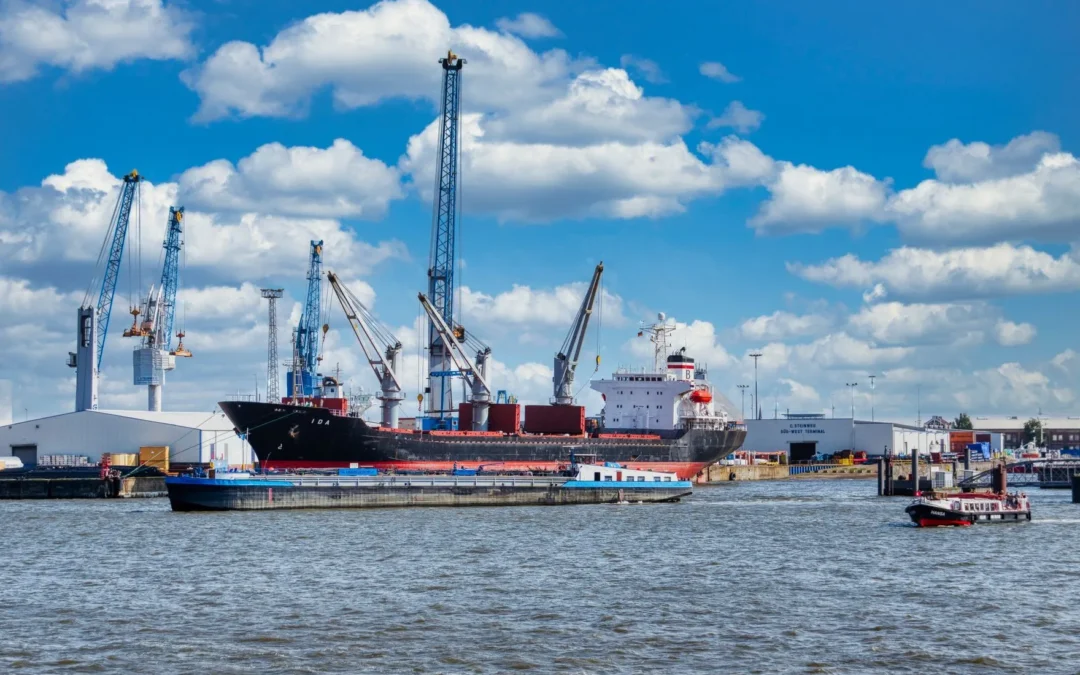
Energy security is usually discussed in terms of reserves, production capacity, refining, pipelines and power generation. Ports rarely receive the same attention.
Yet a significant part of the energy system depends on what happens between the ship and the shore.
Crude oil, refined products and LNG move through maritime infrastructure. So do the equipment and materials needed to build energy projects. Offshore assets depend on shore-based facilities for vessels, personnel, supplies and maintenance.
A port therefore becomes strategically important not simply because of how much cargo it can handle, but because of what the wider energy system depends on it to connect.
The question is not simply how much cargo a port can handle. It is how much of the energy system depends on the port continuing to function.
Ports Are Part of the Energy System
Nigeria offers a useful example of how this dependency is changing.
Between 2020 and 2024, Nigeria imported an average of about 376,000 barrels per day of petroleum products, with gasoline, blending components, diesel and gasoil accounting for almost 87% of those imports.
Those products moved through a chain of ships, terminals, storage facilities, inland transportation and distribution networks before reaching consumers.
As domestic refining capacity expands, that maritime dependency is changing rather than disappearing. The U.S. Energy Information Administration reported that Nigeria’s seaborne petroleum-product shipments averaged 561,000 barrels per day in the second quarter of 2026, compared with an annual average of 79,000 barrels per day in 2023. Exports accounted for 350,000 barrels per day, while intra-Nigerian shipments reached 211,000 barrels per day. Seaborne imports, meanwhile, had fallen to less than 130,000 barrels per day.
The significance goes beyond refining.
Energy infrastructure also depends on ports long before production begins. Turbines, transformers, subsea equipment, steel structures and other specialised components can arrive as project cargo. Offshore assets then require a continuing flow of vessels, equipment, personnel and supplies.
The port is therefore part of the chain that allows energy infrastructure to be built, supplied and operated.
Capacity Is Not the Same as Resilience
That makes physical capacity only part of the equation.
A port may have the berth, storage and cargo-handling capability required under normal conditions and still become a vulnerability when those conditions change.
Can vessels still berth? Can cargo move beyond the terminal? Is another route or facility available? Can equipment, personnel and technical support be mobilised quickly?
The 2015 explosion at the Port of Tianjin illustrates how disruption at one maritime node can spread through connected systems. Port facilities and access routes were damaged, customs and inspection functions were interrupted, and thousands of containers accumulated. UNCTAD notes that oil and gas industries, LNG imports and steel and iron ore trades were particularly affected.
The lesson is not that every port disruption becomes an energy crisis. It is that a strategically important port can become a point of failure for several interconnected systems at once.
Capacity asks what a port can handle when conditions are normal. Resilience asks what happens when they are not.
And resilience extends beyond concrete and steel.
A berth, storage tank or access channel only creates value when the vessels, equipment, personnel, fuel, procurement and maintenance capability required to use them are available. Physical infrastructure and operational capability therefore have to be considered together.
This is where integrated marine and energy support becomes part of the resilience equation. The ability to coordinate vessels, equipment, manpower, procurement and technical support can determine how quickly an energy-facing operation responds when conditions change. This is also reflected in Sealandair Group’s approach to marine and energy support, where operational capability sits alongside the infrastructure itself.
This is particularly important for offshore energy. Production may take place far from land, but the infrastructure supporting it remains connected to the shore. If that connection is disrupted, an otherwise productive asset can face operational constraints.
Energy Security Has a Maritime Dimension
The dependency becomes even clearer at the global level.
Around 20 million barrels per day of crude oil and oil products passed through the Strait of Hormuz in 2025, equivalent to roughly a quarter of global seaborne oil trade. LNG volumes passing through the Strait represented almost one-fifth of global LNG trade.
Hormuz is an extreme example, but the underlying principle applies more broadly.
Energy systems depend on physical connections. When those connections are concentrated in a limited number of ports, terminals, routes or support facilities, disruption at one point can have consequences far beyond the original location.
This is why energy security cannot be measured only by how much a country produces.
A country can have substantial reserves, refining capacity or generation assets and still face vulnerability if the infrastructure connecting those assets to markets, equipment or essential supplies is difficult to replace.
For energy planners and operators, the question should therefore extend beyond capacity: where are the critical maritime dependencies, how easily can they be replaced, and how quickly can the wider system respond when they are disrupted?
Ports Have to Adapt
What ports need to handle will also change as energy systems evolve.
UNCTAD reports that almost 200 ports were offering LNG bunkering services in 2024, while ports are also adapting to new fuels, renewable-energy equipment and changing industrial supply chains.
That means the future value of a port will not necessarily be determined by its size alone.
Adaptability will matter. So will the ability to accommodate changing cargo profiles, vessel requirements, storage needs and energy technologies while maintaining reliable operations.
The ports that matter most to future energy systems may therefore not simply be the largest. They may be the ones capable of adapting.
Ports are easy to overlook because they sit between systems. They are neither the refinery nor the power plant, neither the offshore field nor the fuel station. Yet they connect many of these assets to the wider economy.
Their strategic value is therefore not determined only by what passes through them. It is also determined by what stops moving when they cannot function.
For energy security, the resilience of the port ecosystem is therefore difficult to separate from the resilience of the energy system itself.