
A producing offshore block that has been explored for decades might seem an unlikely place to look for another discovery.
Yet that is exactly what is happening in Angola.
On September 9, Angola’s National Oil, Gas and Biofuels Agency (ANPG) and ExxonMobil announced the Vicango Este-01 discovery on Block 15, which has been producing for more than two decades.
At the same time, TotalEnergies announced another discovery on Block 17 and entered two additional exploration blocks near its existing operations. Chevron has also announced a recent discovery in Block 0.
Individually, these are exploration stories.
Together, they raise a bigger question:
Why are operators still drilling new wells in mature offshore basins?
The answer is not simply that there is still oil underground. Maturity can change the economics of finding and developing it.
Mature Does Not Mean Exhausted
Years of drilling and production give operators something a frontier basin does not have: knowledge.
Seismic data, well results, reservoir information and production history create a better understanding of the geological and operating environment.
There is also infrastructure.
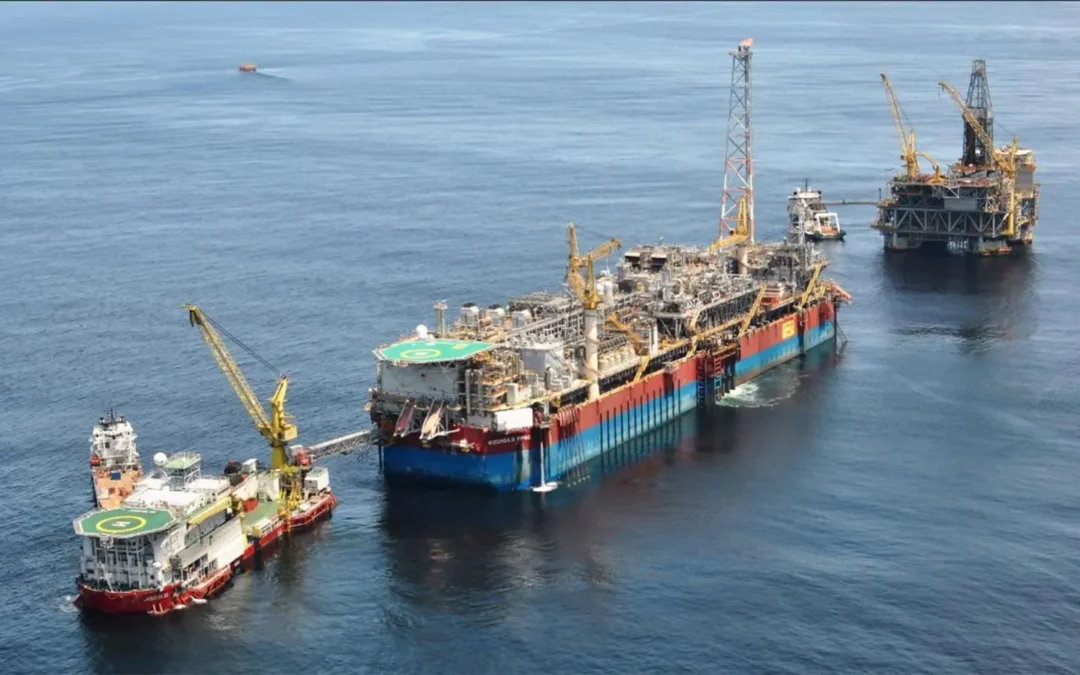
FPSOs, subsea systems, pipelines, export routes and established logistics capabilities may already be in place. A new discovery near those systems does not necessarily require an entirely new development architecture. A subsea tieback can reduce the capital required for a standalone production system by using processing and export infrastructure that is already in place.
It may be possible to connect the discovery to what already exists.
But existing infrastructure is not automatically an advantage. Mature facilities can face corrosion, declining capacity, ageing equipment and maintenance constraints. Brownfield modifications may require costly shutdowns and careful integration, while processing bottlenecks and eventual decommissioning liabilities can reduce the economic benefit of infrastructure that has already been built.
That does not make mature infrastructure a liability by default.
Its value depends on more than proximity. It depends on remaining capacity, condition, remaining life and the cost of modification.
Proximity to existing infrastructure can still materially change the development case.
The Value of What Is Already There
Angola offers a useful example.
ExxonMobil’s latest Block 15 discovery was made within an established offshore production system, rather than in an undeveloped frontier.
TotalEnergies’ recent Acacia-5 discovery on Block 17 makes the point even more clearly. The company said the discovery could be developed using available capacity on the existing Pazflor FPSO, with production potentially beginning just three months after the discovery.
The significance is not simply the oil found.
It is the potential reduction in the distance between discovery and production.
Chevron’s recent Block 0 discovery similarly puts the resource in the context of existing offshore infrastructure as the company evaluates its development potential.
These examples do not mean every mature-basin discovery will be economic.
They show that in mature offshore areas, infrastructure is part of the commercial equation.
The most attractive prospect may not always be the largest. It may be the one that can make the most effective use of infrastructure already in place without inheriting disproportionate brownfield costs.
The Execution Challenge
For mature assets, the development pathway can sometimes shift from:
discover → appraise → develop → build → produce
toward:
discover → appraise → integrate → produce.
The engineering does not disappear. The starting point changes.
Instead of building an entirely new operating system, operators may need to integrate new activity into one that is already producing.
That can involve subsea tie-backs, brownfield modifications, FPSO upgrades, maintenance, equipment mobilisation, marine operations and specialist manpower. It can also mean working within tighter shutdown windows and around systems that cannot simply be taken offline without affecting existing production.
For Sealandair Group, this is where the shift becomes particularly relevant.
As mature offshore assets generate new exploration and development opportunities, equipment, marine capability, technical support, procurement and manpower must be coordinated around infrastructure that is already operating.
The challenge is not simply building something new.
It is integrating something new without compromising what is already working.
A Different Future for Mature Offshore
Angola’s recent activity does not mean mature offshore areas have become new frontiers.
It suggests something more useful: a basin can be mature without being exhausted.
Existing infrastructure and accumulated knowledge can make additional resources more attractive, particularly when the condition, capacity and economics of those systems support further development.
For operators, that can create new development opportunities without starting from zero.
For host countries, it can extend the productive life of established offshore regions.
And for companies supporting these assets, it creates continued demand for the capabilities required to execute increasingly complex work around existing infrastructure.
The future of mature offshore basins may therefore depend less on finding the next frontier and more on extracting additional value from what the industry has already built, while managing the constraints that come with it.
Because in a mature basin, infrastructure is not simply what remains from the previous development cycle.
It can be what makes the next one possible.