
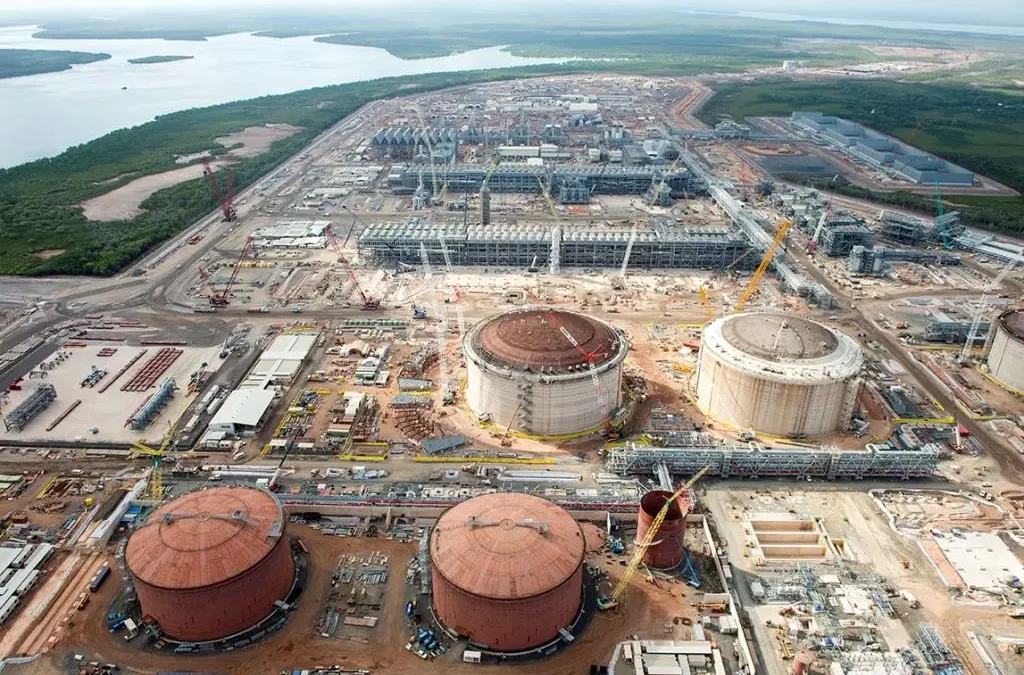
When a major LNG project is announced, attention usually goes to the headline numbers: gas reserves, production capacity, investment value and the number of LNG trains that will eventually come online.
Those figures, however, describe only the most visible part of the development.
Mozambique’s Rovuma LNG project offers a useful example of what sits behind a major LNG development. Alongside the headline liquefaction facilities are offshore EPCI activities, onshore EPC work, shorebase services, local contractors and the marine and logistics infrastructure required to support construction and offshore operations.
That raises a more useful question than simply how much LNG the project will produce: what sits behind the project itself?
The LNG Plant Is Only One Part of the System
An LNG project begins long before gas reaches the liquefaction plant. At the upstream end, wells have to be drilled and completed, reservoirs developed and production brought into a system capable of handling and transporting large volumes of gas.
Offshore, that can involve subsea wells, manifolds, flowlines and gathering systems that connect production to the wider development. The gas then needs a reliable route toward the onshore facilities, creating another layer of pipelines, installation work, engineering and commissioning.
Physical infrastructure is only part of the chain. Large offshore campaigns also require a shorebase capable of supporting vessels, equipment, materials and personnel. Warehousing, maintenance, marine logistics and crew movements all have to be managed around the offshore work programme. This is why an LNG project can generate significant industrial activity well beyond the boundaries of the liquefaction plant itself.
Following the Contract Chain
Rovuma illustrates how this wider system can be divided across multiple work packages. ExxonMobil has announced offshore EPCI activity alongside onshore EPC work, while shorebase services have also been awarded to Mozambican companies.
These contracts may sit in different parts of the project, but they are connected by the same execution schedule. The chain runs from upstream production through subsea systems and pipelines to shorebase support, onshore liquefaction and storage, and finally the shipping network that moves LNG into international markets.
Upstream development creates the gas supply, while subsea infrastructure gathers production offshore and pipelines provide the connection toward the onshore facilities. Shorebase operations support the vessels, equipment and personnel required to execute offshore campaigns, while EPC and EPCI contractors deliver major facilities and systems that must eventually operate as part of the same development.
The important point is that these are not independent activities. A delay in offshore construction can affect pipeline installation. Limited shorebase capacity can constrain marine campaigns. Equipment arriving late can disrupt installation schedules, while incomplete upstream or pipeline systems can prevent completed processing facilities from operating at full capacity.
The project therefore has to be managed as a connected system rather than a collection of individual contracts.
Where the Broader Opportunity Sits
This also changes how the economic footprint of an LNG project should be understood. The headline investment figure captures the scale of the development, but the associated activity extends across engineering, procurement, marine services, logistics, equipment supply, warehousing, technical support, maintenance and specialist manpower.
Some of that work takes place directly at the LNG facilities, while other activities are concentrated offshore, around ports and at shorebases. Local companies can also enter the supply chain through service contracts and subcontracting opportunities, as the Rovuma shorebase awards demonstrate. The result is an execution ecosystem that extends far beyond the main construction site.
This creates an important distinction between building an LNG plant and building an LNG project. The plant is the physical facility, but the project encompasses the much larger network of infrastructure, contractors, suppliers and operational capabilities required to make that facility possible.
This wider execution ecosystem is where Sealandair Group’s capabilities become relevant. Large energy developments require more than engineering. They require procurement, marine capability, technical support, equipment, vessel services and manpower that can operate within the schedules and constraints of a complex project.
The opportunity, therefore, is not limited to the largest EPC contract. It exists across the execution chain surrounding the asset.
The Real Complexity of LNG
That interconnectedness is what makes LNG projects so demanding to execute. Completing one major facility does not mean the project is ready. The wider systems around it must also be engineered, supplied, installed, commissioned and integrated at the right time.
The LNG plant may be the most visible asset in the development.
But the project only works when everything around it works too.
An LNG project is not a plant. It is a chain of infrastructure, contracts and operations that has to function as one system.