
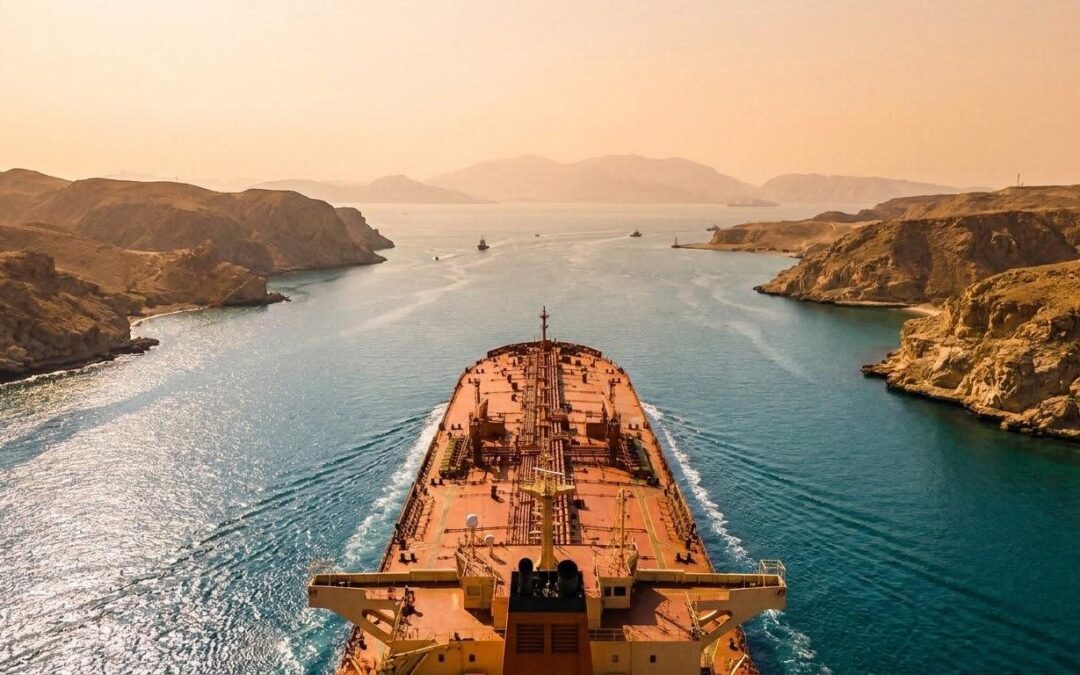
A waterway only a few kilometres wide can influence the movement and cost of energy thousands of kilometres away.
That is the significance of maritime chokepoints. Global energy production is spread across continents, but a substantial share of the seaborne oil, petroleum products and LNG connecting producers with consumers passes through a relatively small number of strategic waterways. The Strait of Hormuz, Strait of Malacca, Suez Canal and Bab el-Mandeb are among the most important.
The scale is considerable. In 2025, about 20.9 million barrels per day of crude oil, condensate and petroleum products moved through the Strait of Hormuz, equivalent to roughly one-fifth of global petroleum liquids consumption. In the first half of 2025, around 11.4 billion cubic feet per day of LNG also passed through the strait.
So why can a disruption in one narrow passage have consequences across such a large energy system?
The Geography Behind the Chokepoints
Chokepoints matter because there are not always convenient alternatives.
The Strait of Hormuz connects the Persian Gulf with the Gulf of Oman and the Arabian Sea. It is a critical export route for oil and LNG from the Gulf, much of which is destined for Asian markets.
The Strait of Malacca performs a different role, connecting the Indian and Pacific oceans and providing a major route for energy moving towards Asia. In 2025, approximately 23.2 million barrels per day of oil and petroleum products passed through the strait, according to the U.S. Energy Information Administration.
Further west, the Suez Canal and Bab el-Mandeb form part of the maritime connection between Asia, the Middle East and Europe. Their importance is not only the cargo they carry, but also the distance they save compared with alternative routes.
This means a chokepoint does not have to be completely closed to create consequences. Security concerns or the decision by operators to avoid a route can be enough to change the economics of a voyage.
When the Route Changes, the Voyage Changes
The Red Sea disruption demonstrated this clearly.
As vessels avoided the Bab el-Mandeb and Suez route, many were redirected around the Cape of Good Hope. According to UNCTAD, a voyage from Shenzhen to Rotterdam that normally covers about 10,000 nautical miles through Suez can increase to approximately 13,000 nautical miles when routed around the Cape. The journey can also increase from around 31 days to 41 days.
That additional time affects more than the individual cargo.
A vessel spending longer at sea is unavailable for its next assignment. Fuel consumption increases, schedules move, and more shipping capacity may be required to maintain existing flows. UNCTAD estimated that rerouting around the Cape increased global vessel demand by about 3% and container-ship demand by 12% in June 2024 compared with a scenario without the Red Sea rerouting.
The result is a useful reminder that maritime disruption can spread through the wider logistics system.
The Port Is Part of the Problem
The consequences do not stop at sea.
When vessels take longer routes, their arrival times change. That can affect berth planning, cargo handling, storage, bunkering and the scheduling of other vessels.
UNCTAD reported that rerouting around the Cape contributed to port congestion and higher costs as longer voyages altered the balance between shipping demand and available capacity.
For energy operations, this matters because cargoes are part of interconnected supply chains. A tanker or LNG carrier is linked to production facilities, export terminals, receiving ports, storage and onward distribution.
A delay at sea can therefore become a scheduling issue at the terminal, and eventually an issue for the wider supply chain.
Resilience Requires More Than an Alternative Route
The obvious response to a chokepoint disruption is to look for another route. But an alternative is not necessarily an equivalent one.
A pipeline may bypass part of a maritime route but have limited capacity. A vessel may be able to take a different route, but that route could add thousands of nautical miles and require additional vessels to maintain delivery schedules.
Hormuz illustrates the challenge. EIA estimates that Saudi Arabia and the UAE have about 4.7 million barrels per day of crude oil pipeline capacity that can bypass the strait, compared with the roughly 20.9 million barrels per day of crude, condensate and petroleum products that moved through Hormuz in 2025.
Resilience therefore depends on more than geography. It also involves contingency planning, procurement, vessel availability, port capacity and the ability to adjust operations when conditions change.
For energy and maritime operators, operational readiness can become critical when normal routes or supply arrangements are disrupted. Procurement, project management, technical support, vessel availability and equipment sourcing all form part of that response. These are areas where Sealandair Group supports energy-sector and maritime operations.
A Small Passage, A Much Larger System
The real importance of a maritime chokepoint is not its size, but the system that depends on it.
Hormuz connects major energy exporters with Asian consumers. Malacca provides a critical link between the Indian and Pacific oceans. Suez and Bab el-Mandeb form part of a major route between Asia, the Middle East and Europe.
Their physical dimensions may be small compared with the global network they serve, but a disruption can affect voyage times, vessel utilisation, port schedules and supply-chain planning far beyond the waterway itself.
Energy security, therefore, is not only about how much oil or gas is produced. It also depends on how reliably that energy can move from where it is produced to where it is needed.
In global energy, the route between supply and demand can be just as important as the supply itself.