
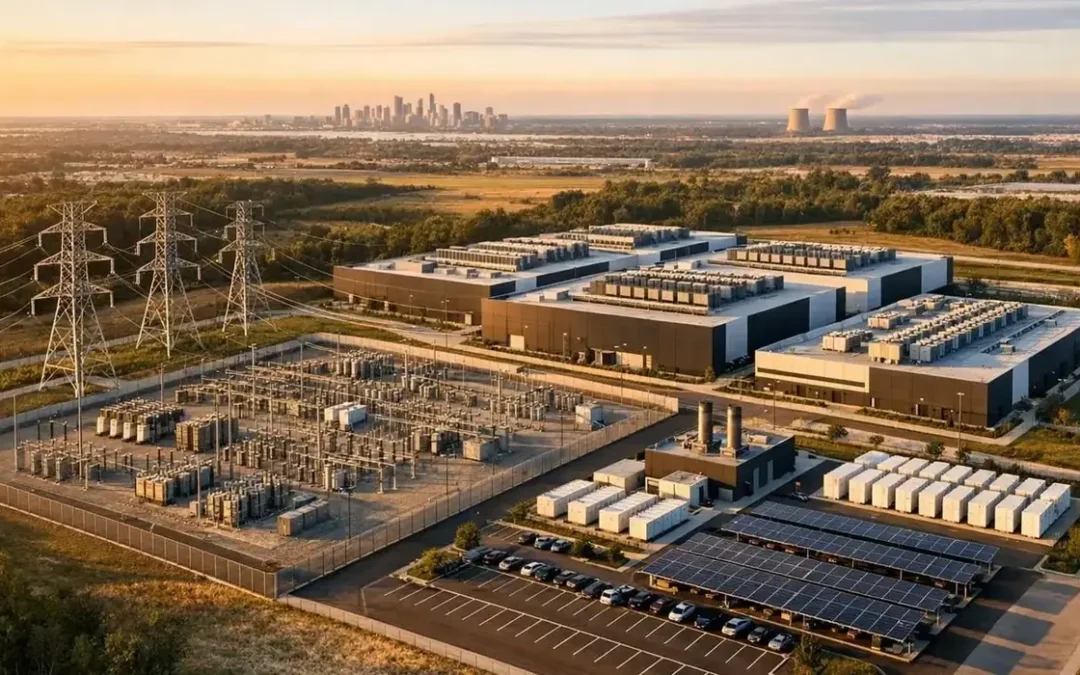
A data centre may look like a specialised industrial building.
But its value is not determined by the structure alone.
Before the land, floor area, or construction specification can support a viable investment, the site must answer a more fundamental question:
Can it secure enough reliable power to operate?
Data centres consumed approximately 415 terawatt-hours of electricity in 2024, around 1.5 per cent of global electricity consumption, according to the International Energy Agency’s 2025 Energy and AI report.
This is why data centres cannot be assessed like conventional real estate. Their performance depends as much on the infrastructure surrounding the building as on the building itself.
Power Comes Before Property
For most commercial assets, electricity is an operating requirement considered after location and design.
For data centres, it is often the first site-selection test.
A suitable parcel of land may have limited development value if sufficient grid capacity is unavailable or cannot be delivered within the project timeline. JLL’s 2026 Global Data Centre Outlook reports that average grid-connection waiting times in primary markets exceed four years and identifies speed to power as the leading site-selection criterion.
Consider a developer that secures suitable land near a major market, only to discover that the required grid connection will not be available within the planned development schedule. The site remains physically suitable, but the delay can affect construction timing, tenant commitments, financing, and the overall investment case.
Investors must therefore consider available capacity, connection timelines, electricity pricing, grid reliability, expansion requirements, and the ability of local infrastructure to support continuous demand.
Backup generation is equally important. Generators, batteries, uninterruptible power systems, fuel arrangements, and maintenance requirements form part of the asset’s core operating infrastructure rather than secondary additions.
Cooling and Water Shape the Design
The energy consumed by computing equipment generates heat that must be removed continuously.
Cooling strategy directly affects energy use, building design, development capacity, and operating costs. As computing density increases, the cooling system may also determine how much processing capacity a facility can support.
In water-constrained locations, cooling technology can influence whether a site is commercially or operationally viable. Water use varies according to local climate, watershed conditions, operating practices, and the selected cooling system, making it a site-specific investment consideration rather than a universal calculation.
A site with abundant power but unsuitable cooling or water conditions may require a more expensive design or support less computing capacity than expected.
Connectivity Still Determines Usefulness
Power makes a data centre operable. Connectivity makes it useful.
Facilities require reliable fibre networks, sufficient capacity, route diversity, and telecommunications redundancy. A failure along one route should not isolate the facility or disrupt the services it supports.
Location decisions must therefore balance power availability with proximity to users, network infrastructure, security, regulation, environmental conditions, and future expansion.
Cheaper land does not automatically produce a stronger investment. A remote site may offer space and energy but lack the network infrastructure required by its intended users. A well-connected urban location may face limited power availability, higher land costs, or restricted expansion.
Infrastructure Shapes the Investment Case
Infrastructure readiness affects both the operating potential and financial profile of a data-centre development.
Delayed grid access can extend land-holding periods, postpone rental income, disrupt pre-leasing commitments, and increase financing exposure. Long procurement periods for transformers, switchgear, generators, batteries, and cooling equipment can create similar pressure after power has been secured.
The building and its supporting infrastructure must therefore be assessed as one investment system.
Evaluating the Complete Operating Environment
At Sealandair Global Investments, we see data-centre investment as the point where real estate, energy, infrastructure, and long-term operations converge.
The strength of a site depends on decisions made before construction begins: whether sufficient power can be secured, whether the cooling strategy suits the location, whether water requirements are sustainable, whether connectivity is resilient, and whether the asset can expand as demand changes.
For us, evaluating a data-centre opportunity means looking beyond land and construction potential to determine whether the complete operating environment can support reliable performance throughout the life of the asset. This reflects the company’s broader focus on viable and sustainable real-estate investments across multiple markets.
Data centres remain one of real estate’s major growth themes, but growth alone does not make every site investable.
The strongest assets will be those where power, cooling, water, connectivity, and location have been considered as one operating system from the beginning.