
An offshore discovery can generate headlines long before it generates revenue.
The announcement of a major find can signal new reserves, future production and renewed confidence in an energy basin. But the discovery itself is only the starting point. Between identifying hydrocarbons and producing them commercially lies a chain of appraisal, development planning, approvals, investment, engineering, procurement, infrastructure and execution.
The experience of Guyana’s Liza field shows what is possible when that chain moves efficiently. The Liza-1 discovery was announced in May 2015, and production from Liza Phase 1 began in December 2019, about four and a half years later. ExxonMobil described this as well ahead of the industry average for a deepwater development.
That is not a standard timeline for offshore developments. Field characteristics, development concepts, infrastructure, investment and regulatory requirements vary significantly. But Liza demonstrates an important point: the period between discovery and first production is shaped by more than the resource itself.
The question is therefore not only how much has been discovered?
It is also how effectively can that discovery be developed and brought into production?
A Discovery Is Only the Beginning
A discovery establishes the presence of hydrocarbons. It does not establish that the resource is ready for commercial development.
Appraisal work helps determine the size and characteristics of the reservoir and reduce uncertainty. Developers then have to select an appropriate development concept, assess the economics and make the investment decisions required to move the project forward.
The development pathway can differ significantly from one field to another.
A discovery close to existing production infrastructure may have access to facilities, pipelines or processing capacity that support development. A remote deepwater discovery may require new subsea systems, floating production facilities, export infrastructure and extensive offshore construction.
The difference is significant because a resource in the ground and a producing asset are not the same economic proposition.
What Determines the Pace?
The time to first production is shaped by several connected factors.
Field characteristics influence the technical complexity of the development. Water depth, reservoir conditions, well requirements and expected production rates all affect the development concept.
Investment decisions determine whether a technically viable project moves forward. Large offshore developments require substantial capital, and decisions are influenced by development costs, expected production, commodity prices and financing conditions.
Regulation also forms part of the development pathway. Environmental assessments, approvals, permits and local-content requirements need to be incorporated into project planning from the beginning.
Then there is development readiness.
A project can have an attractive resource, a sound development concept and the necessary investment while still depending on the availability of equipment, vessels, fabrication capacity, specialist personnel and logistics.
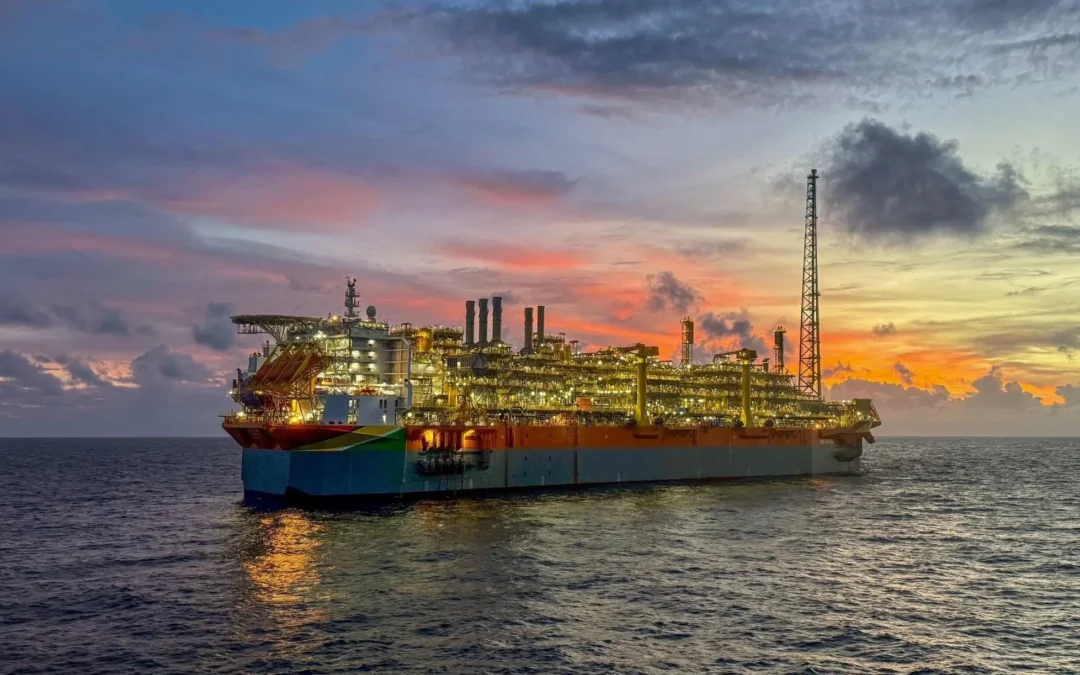
The Liza development provides a useful example. Its first phase used the Liza Destiny FPSO, supported by four subsea drill centres and 17 wells, rather than a conventional fixed production platform. ExxonMobil had also converted an oil tanker for use as the FPSO.
That development approach formed part of a wider execution programme that moved Liza from discovery to first production in less than five years. Developments without suitable infrastructure, established supply chains or comparable development options can face a very different path to production.
The point is not that the same approach will work for every offshore discovery. It is that development choices can materially influence how quickly a resource can move toward production.
Where Execution Is Tested
The transition from development planning to physical execution is where those dependencies become tangible.
Equipment has to be sourced, inspected and delivered. Components need to reach fabrication or mobilisation locations. Specialist personnel need to be available for the activities they are required to perform. Marine assets have to be scheduled for transportation, installation and offshore work. Shore-based logistics have to support the movement of materials and people throughout the operation.
These activities may involve different organisations, but they remain connected within the same development.
A procurement issue can affect fabrication. A change in engineering can alter equipment requirements. Vessel availability can affect an installation sequence. A specialist team that is not ready at the required stage can prevent other resources from being used effectively.
The issue is not simply whether each resource exists. It is whether the resources required for a particular stage of the development are ready when that stage begins.
That makes execution capability an important part of development readiness.
It also does not mean every project should pursue speed at any cost. Safety, engineering integrity, environmental requirements and regulatory compliance remain fundamental. The objective is to reduce avoidable friction without compromising those standards.
This is where integrated solutions become important. Marine services, equipment, procurement, manpower and logistics all contribute to the execution environment required to move an energy project from development planning toward offshore delivery.
From Discovery to Production
An offshore discovery creates an opportunity, but development readiness determines how effectively that opportunity can become production.
The journey requires more than proving that hydrocarbons exist. It requires the technical, commercial, infrastructure and operational capabilities to move the project forward and ultimately bring the resource to market.
That is the question facing offshore developments:
How ready is the project to turn a discovery into a producing asset?
In offshore energy, finding the resource creates the opportunity. Development readiness and execution determine how effectively that opportunity becomes production.