
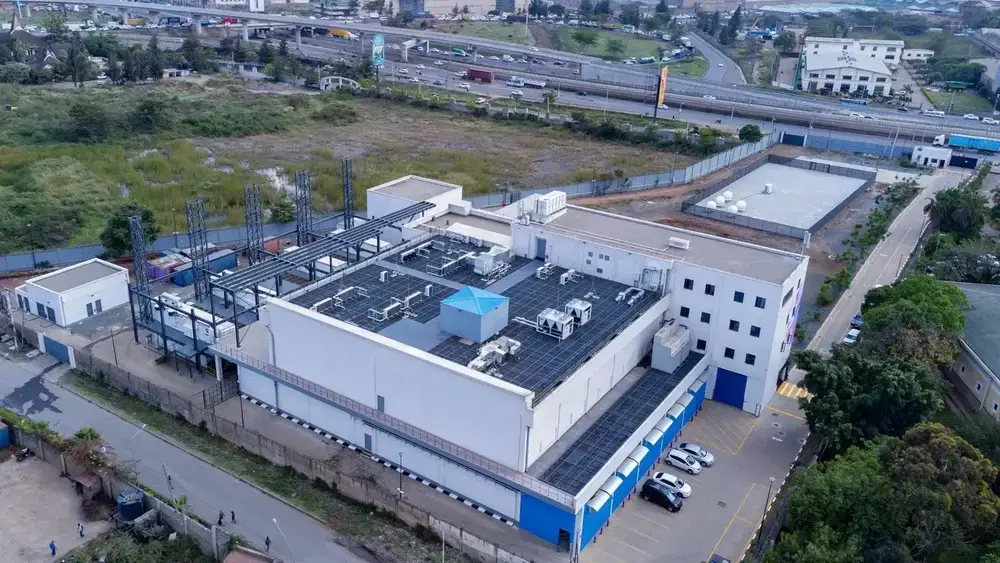
Africa’s data-centre growth is often discussed in terms of digital demand: more cloud services, greater connectivity and more businesses moving operations online.
But behind that growth is a much broader infrastructure requirement.
According to the African Data Centre Association’s 2026 industry report, Africa has around 360 MW of active data-centre capacity, with another 238 MW under construction and 656 MW planned. The continent currently represents just 0.6% of global data-centre capacity, leaving significant room for growth.
A data centre is not simply a building filled with servers. It is a complex infrastructure system whose reliability depends on how its critical systems are planned, connected and operated.
Power Is the Foundation
Electricity is one of the most critical requirements for any data centre, but the challenge is not simply having access to a grid connection.
The African Data Centre Association’s 2026 report identifies power availability as the sector’s principal constraint, overtaking connectivity.
Data centres therefore require layers of resilience, including backup generation, energy storage, electrical distribution systems and redundancy. As facilities expand and computing becomes more power-intensive, electrical capacity must also be able to scale.
Power infrastructure needs to be considered from the beginning of the development strategy.
Cooling and Connectivity Matter Too
Servers generate significant amounts of heat, making cooling a critical part of data-centre infrastructure. Depending on the facility, this can involve chillers, cooling towers, pumps, heat exchangers and other cooling technologies.
Water requirements also vary according to the cooling system and local conditions. This is particularly important across Africa, where water availability differs considerably between markets and some regions face significant water-stress pressures.
Cooling strategy therefore has to consider not only technical performance, but also the availability and sustainability of the resources required to operate the system.
Connectivity is equally important. Data centres need access to fibre networks and, in some locations, submarine cable infrastructure. Diverse routes can also reduce dependence on a single connection.
Location Is an Infrastructure Decision
Data-centre developers have to consider access to power, fibre, roads, water, security and supporting infrastructure, as well as whether a site can accommodate future expansion.
Extending power capacity, establishing diverse fibre routes or developing adequate supporting infrastructure can materially affect the economics and schedule of a project.
Data-centre development therefore becomes an infrastructure-planning exercise before construction even begins.
Delivery Is Not Readiness
The digital economy still depends on a physical supply chain.
Servers, transformers, generators, switchgear, cooling equipment, batteries, cables and other specialised components may come from different manufacturers and locations. They have to be procured, transported, received and installed in the right sequence.
But physical delivery is not the same as operational readiness.
Equipment arriving on site is only one stage of the process. It must be installed, tested, integrated and commissioned before it can support live operations.
This is where logistics becomes part of project execution rather than simply transportation.
Reliability Is the Real Objective
The infrastructure supporting a data centre ultimately has one purpose: maintaining reliable operation.
Power, cooling, connectivity, water, security and logistics cannot be planned as completely separate systems. A weakness in one can place pressure on the others.
A facility may have sufficient electrical capacity but inadequate cooling. It may have excellent connectivity but limited access to critical equipment. It may have a suitable building but insufficient space to expand its supporting infrastructure.
This is where Sealandair Group’s role in energy and infrastructure projects becomes relevant: coordinating procurement, logistics, technical requirements and operational activities so that the resources required for execution are aligned with the wider project sequence.
Africa’s data-centre opportunity will depend on more than adding computing capacity. It will depend on developing the infrastructure needed to keep that capacity operating reliably.
The next phase of Africa’s digital infrastructure will be shaped not only by where data centres are built, but by how well the infrastructure around them is planned and connected.