
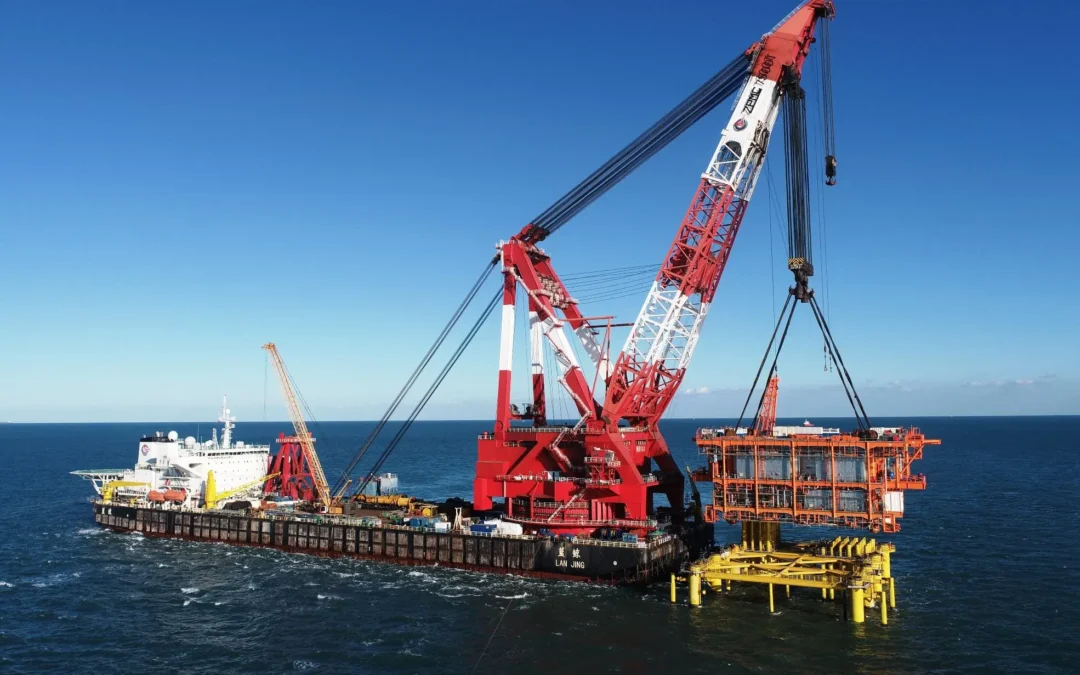
Nigeria’s offshore oil and gas sector is entering a more active phase. After years of long project cycles and investment uncertainty, several major developments are moving closer to execution. NUPRC has identified 22 major offshore projects expected between 2026 and 2030, representing an estimated $30 billion to $50 billion in investment potential.
As projects move from approvals and investment decisions into procurement, fabrication, drilling and installation, another question becomes increasingly important: can the physical resources required to execute them be secured when they are needed?
The issue is not necessarily that Nigeria lacks equipment today. It is whether the right vessels, subsea systems, heavy-lift equipment, fabrication capacity and specialist personnel will be available if several projects enter execution at the same time.
When Available Doesn’t Mean Available
An offshore asset can exist without being available to a particular project. A vessel may already be committed elsewhere, a drilling rig may be technically suitable but under contract, or specialised equipment may require months of preparation before mobilisation.
Availability therefore means more than existence. An asset must be physically available, technically suitable, commercially accessible and capable of reaching the project within its required timeframe.
This becomes even more important for deepwater developments, where specialised vessels, ROV systems, heavy-lift equipment and project-specific subsea systems can significantly narrow the pool of suitable assets.
The result is that an equipment constraint may not look like an empty market. It may appear as longer lead times, fewer options, higher charter costs or a mobilisation schedule that no longer fits the project.
Nigeria Is Part of a Global Market
Nigeria’s requirements also compete within an international offshore market. Brazil, Guyana and other active regions draw from overlapping pools of vessels, rigs, equipment manufacturers and specialist contractors.
Recent drilling activity illustrates the wider market. High-specification offshore rigs continue to command substantial day rates, with current market data placing average rates for sixth-generation and seventh-generation drillships at roughly $371,000 and $407,000 per day.
Nigeria is already participating in this market. ExxonMobil and its partners have committed approximately $1 billion to the Usan Infill Project, expected to add up to 40,000 barrels per day and involving renewed deepwater drilling activity.
Nigeria has also built significant local capability across fabrication, marine services, logistics and upstream support. But local participation and local capacity are not the same thing. A contractor may have the expertise but limited spare equipment, while a fabrication yard may have the capability but limited available capacity.
The question is whether that capacity can scale with demand.
The Real Risk Is Project Overlap
The 22 projects identified by NUPRC will not all compete for equipment at the same time. Some may progress quickly, others may face delays, and some may be executed in phases. Staggered activity gives suppliers time to sequence campaigns and redeploy assets.
The risk changes if several major developments move through FID, procurement, fabrication, drilling and installation within overlapping periods.
Brownfield activity adds another layer. Existing offshore fields will continue to require maintenance, intervention, upgrades and drilling, creating recurring demand alongside new developments.
The risk is therefore not simply the size of Nigeria’s offshore pipeline. It is how much of that pipeline enters execution at the same time.
What the Market Should Watch
The next FIDs, EPC and EPCIC awards, vessel contracts, fabrication awards and subsea contracts will provide clearer signals of how quickly project demand is building.
Mobilisation may be the clearest signal. Once vessels, equipment and personnel begin moving, project requirements have entered the physical supply chain.
For operators and contractors, this makes equipment strategy increasingly important. The advantage may not belong simply to those that own the most equipment, but to those that can identify, secure and mobilise the right assets when required.
Supporting the Execution
This is where Sealandair Integrated Solutions provides a practical link to the evolving market.
The company provides vessel fueling, short- and long-term equipment and vessel leasing or purchasing, supporting clients that require marine assets, equipment and operational capacity for their projects.
As offshore activity increases, access to these resources can help clients respond to changing requirements and tighter mobilisation windows.
Conclusion
Nigeria’s offshore pipeline is becoming increasingly tangible, but a growing project pipeline does not automatically mean an equipment shortage.
The real question is whether vessels, specialised equipment, fabrication capacity and skilled personnel can be secured and mobilised when multiple projects require them.
If activity accelerates, the constraint may not appear at the investment stage. It may emerge further down the execution chain.
Nigeria has the projects. The question is whether the equipment will be ready when the projects are ready to move.