
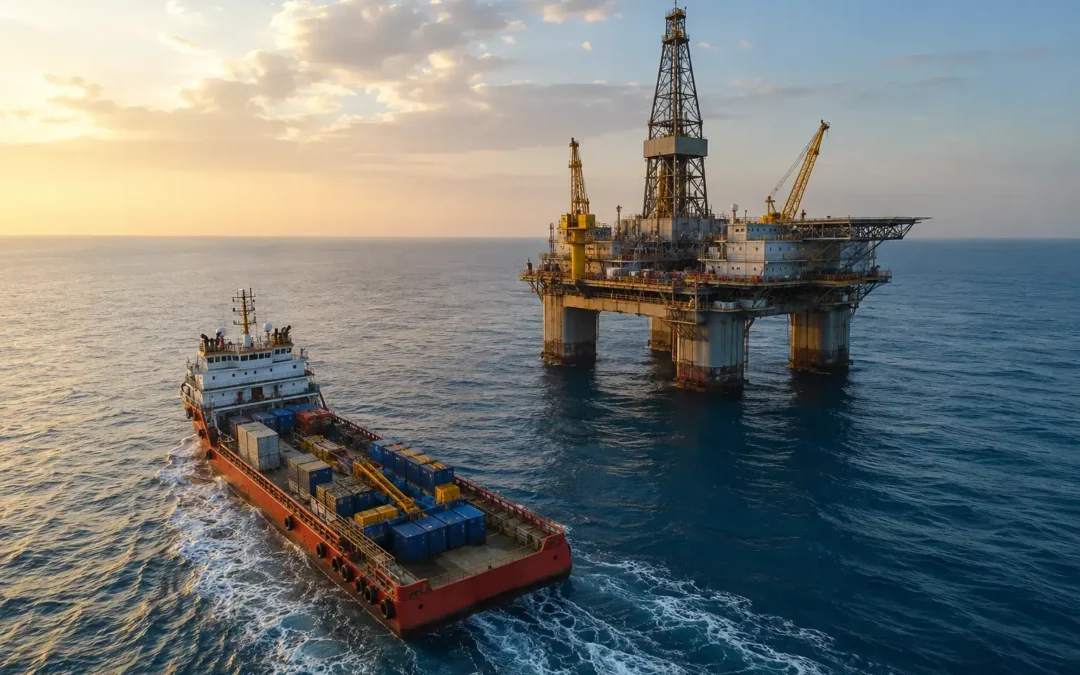
An offshore well does not begin when the drill bit enters the seabed.
Long before drilling starts, a complex chain of decisions and activities is already underway. Equipment has to be specified and procured. Materials need to be inspected, certified and prepared for mobilisation. Vessels and offshore support services must be scheduled. Specialist personnel need to be available. Shore bases have to receive, store and consolidate cargo, while customs, documentation and regulatory requirements must be completed.
The objective is not simply to move equipment offshore. It is to ensure that the right equipment, people and support are available when the drilling programme needs them.
Procurement Starts the Offshore Operation
Offshore drilling campaigns depend on equipment from multiple suppliers, often with different lead times and delivery requirements.
Tubulars, drilling equipment, subsea components, specialist tools, consumables and critical spares all have to be available in the required quantities and condition. Some equipment may require inspection, testing or certification before it can be mobilised.
Procurement therefore has to be planned around the offshore programme rather than treated as a separate activity.
A component that arrives late can disrupt cargo consolidation and vessel loading. If the vessel then misses its planned sailing window, the consequences can extend into the offshore work sequence.
The Shore Base Connects the Supply Chain
Before cargo reaches an offshore asset, it often passes through a shore base operation.
Materials may arrive from different suppliers and locations before being received, inspected, stored, consolidated and prepared for offshore transport. Cargo may also need to be packaged and sequenced according to when it will be required offshore.
This creates a balance between readiness and efficiency. Sending everything offshore too early can increase handling, storage and inventory requirements. Sending critical equipment too late can expose the campaign to delays.
The shore base is therefore more than a storage point. It is where separate deliveries are organised into a mobilisation plan that supports offshore execution.
Vessels and People Have to Align
Offshore operations operate within constraints that do not always exist onshore.
A vessel may be available for a defined charter period. Specialist personnel such as drilling specialists, subsea technicians, survey teams or equipment technicians may have limited availability. Port schedules can affect mobilisation, while weather and sea conditions can influence when offshore activities can safely take place.
Consider a campaign where critical equipment has reached the shore base but a specialist team is delayed. The vessel may still be ready to sail, but the planned offshore sequence may no longer be achievable. Sending the team offshore before the equipment arrives creates a different problem: personnel and vessel time may be committed without the resources required to complete the work.
The supply chain therefore has to coordinate not just what moves, but when each resource becomes operationally useful.
Readiness Requires Contingency Too
Coordination does not mean eliminating every buffer.
Offshore projects often require contingency planning because the consequences of a missing component or delayed support service can be significant. Critical spares may need to be positioned in advance. Alternative suppliers or transport arrangements may be considered for particularly important equipment. Additional vessel or personnel capacity may also be justified where the consequences of delay outweigh the cost of maintaining additional flexibility.
That creates a trade-off between resilience and efficiency.
The right level of contingency depends on the criticality of the equipment, the operating environment and the consequences of failure. Effective supply-chain planning is therefore not about synchronising everything perfectly; it is about knowing where flexibility is worth paying for.
When Supply Chain Becomes Execution
The distinction between logistics and project execution becomes less clear offshore.
Imagine a drilling campaign where the rig, cargo and crew are all ready, but a critical subsea component has not completed its required inspection. The vessel may be mobilised, personnel may be on location and other equipment may be ready, yet the planned sequence cannot proceed as intended.
The issue is no longer simply that one item is late. The value of the resources already mobilised is affected by a gap elsewhere in the chain.
This is why procurement, logistics, technical requirements, workforce planning and project coordination need to be considered as connected parts of the same delivery strategy.
At Sealandair Group, this connection is central to how we support offshore energy projects, coordinating the resources, technical requirements and project activities needed for offshore execution.
When those elements are planned together, supply-chain decisions can be made with the wider operational sequence in mind rather than in isolation.
The Well Is Only the Visible Start
By the time the first well is drilled, much of the work that enables it has already taken place.
Suppliers have been coordinated. Equipment has been inspected and prepared. Cargo has moved through the shore base. Vessels and personnel have been scheduled. Documentation and mobilisation requirements have been addressed. Contingencies have been considered.
The well is therefore not the beginning of the project. It is the point at which months of preparation, procurement, coordination and mobilisation become visible in the offshore operation.
In offshore energy, drilling starts at the well. Successful execution starts much earlier.